
Quarantine has been extended to the beginning of May. I’ve applied for unemployment and spent a lot of time laying in bed watching Law & Order: SVU. So much so that I’ve now watched all of the seasons that are available for free on Amazon.
What this quarantine taught me in the last few weeks is that I’m a pretty regular person. That in the large scheme of things, I’m fairly normal. Sure, everyone thinks they’re exceptional, special even, but when the quarantine comes down we all resort to sourdough. I’ve seen several posts, stories, texts, you name it, from friends with their pride, their new starter. My facebook neighborhood group has a new ISO or PPU offer for sourdough starter 2-3 times per day with the popularity pushing them to the top of the feed every time. Someone stapled small baggies of starter to telephone poles in Bernal Heights, introducing their starter, “Godric”. This made the news.
I find it so strange, or maybe a better word is invigorating, that in this time we’re resorting to things of the past. Sewing face masks. Who these days has pulled out their long-dusty sewing machine for the call to arms, to protect our health workers and loved ones? Who is revisiting their grandmother’s tips for curing or preserving produce and meat? Who is having the first real opportunity to be a stay-at-home parent?
There are so many moments from our past that have seemingly popped back into existence in this time where we’re forced to slow down. What exactly, has been pushing us to speed up, speed up, speed up? A few days ago, I realized that it takes me 1-2 minutes to unload the dishwasher. It takes my partner 5-10. Why? I tried to pay attention the next time I unloaded it. I literally spend 10 seconds surveying what is in the dishwasher and then categorize how to unload it. It means I hit each storage location once, maybe twice, before I can move on to the next. For example, silverware is piled together in matching sets (small spoons, big spoons, steak knives, butter knives, random) in the rack they’re washed in, and then grabbed in one, maybe two hands, piles separate by fingers, to drop into the appropriate locations in the drawer. Ten seconds organizing, five seconds putting away. In what ways am I applying this goal of efficiency to my everyday tasks, to things that are supposed to speak of leisure?
In what ways do you: maximize your planning, to maximize your efficiency, to minimize your time spent doing something. It could be a house chore. A leisure activity. Exercise. When is the last time you literally just sunk into something, with no plans or scheming around the completion, or final act?
What would it be like to just do something, with no expectations for outcome? I can’t remember what that feels like. I know I used to. This is what childhood is made of, at least when you grow up privileged. And I’m left wondering, is it only me, in this state of unemployment where my previous day-to-day involved planning planning planning for maximum outcome? I don’t think efficiency is bad, I think it’s simply not the only way to live. Especially during these days where we’re forced to slow down.
What everyone’s search for sourdough has taught me, is that we’re all normal here. Normal is feeling uncomfortable with this time to slow down and seeking something to care for, to do, to be efficient at, in this time of unknown. We all need a scapegoat for what is going wrong, for our feelings of anger and anxiety. And it is fascinating to watch it play out in a form that is uncontrollable – no one has a home lab where they can consistently monitor the yeasts in random flour, air, water activity, etc. Shit even food labs don’t care about these things on a normal day.
What isn’t normal, and perhaps what we should be using this time to question, is our incessant need to be efficient, to be effective, to maximize our outcome and how does that affect our opinions of “right” and “just” and “good” when it comes to our neighbors? With German ancestry, I truly identify with the work ethic part of my identity. Without it, I feel unmoored, untethered.
The question of what does it mean to be human is under a magnifying glass right now, and our individual identities are at odds with this force of nature, coronavirus, who doesn’t consider what you look like or smell like before infecting you. But our individual societies are also under a microscope. Why, in this time of a virus that SHOULDN’T target some communities more than others, is it affecting marginalized communities more?
There’s been a lot of “what” “what” “what” here so far. I think the “why” has become my focus. It feels cliche but sourdough has taught me a lot about myself in this past week. I felt very defeated by my first failure and insisted on learning more more more on how to try again successfully, and it really prevented me from even starting in the first place.
- Why do I need to be successful at this? (Because if I’m not it would be a waste of time)*
- Why do I need to know everything about yeasts and bacteria in flour? (Because if I know everything about them, I can control them)**
- Why am I doing this? (Because if I can naturally leaven bread, I can feed us if things go further south)***
*How could I possibly waste time in this situation? We have nothing but time.
**I can’t control anything.
***There will be bigger problems if this goes further south.
I’ve really digressed, my friends. But please extrapolate what I’m learning about myself and apply these feelings of need for control and need to prove I’m productive and successful to society as a whole. This really comes back to value, how we value our human lives, how we value our neighbors, and how broken capitalism is. In a week where I have literally nothing other than a few phone calls to make, why am I plotting on how to unload the dishwasher the fastest and most efficient way possible? What if, instead, I took joy in the movements that my body is still capable of making: bending over, gripping things with my fingers, looking at something and really seeing it. Why do I hate to slow down so much? Why does society? (hint hint, money).
I’m trying, really hard, to slow down. I’m trying really hard to remember dharma. What is the great work of my life?
Then my partner got involved and it’s like I’m seeing this thing through a whole new lens. Whereas before it was something I wanted to succeed at, to make me productive, to make me a master of sorts, now it’s something to talk about. Something to work on, together. Something to slow us both down. It’s fun. It’s play. Something to teach me that my way, isn’t the only way, and that the only guru in bread making, is the dough, the flour, the water, and nature in general. This bitch is teaching me some hard lessons. What a 180 from “it’s not witchcraft” eh?
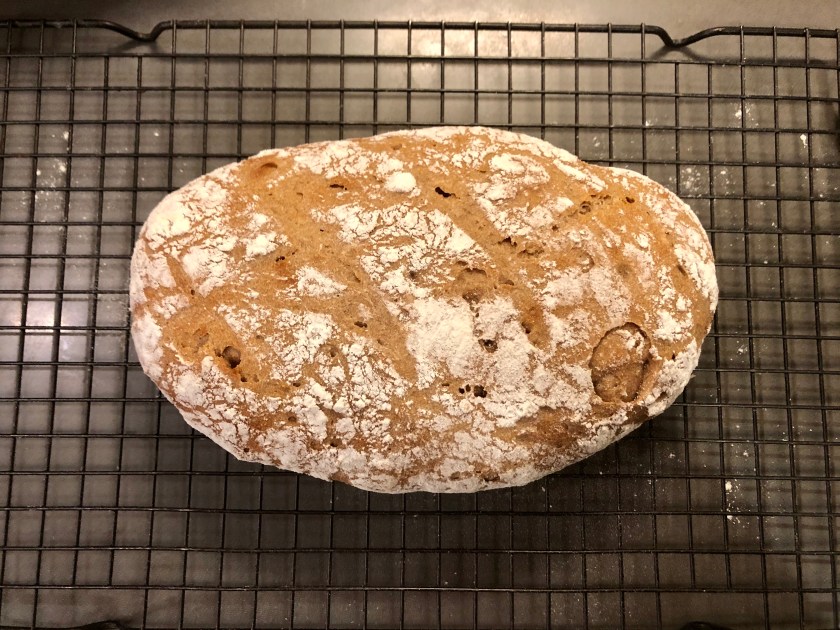
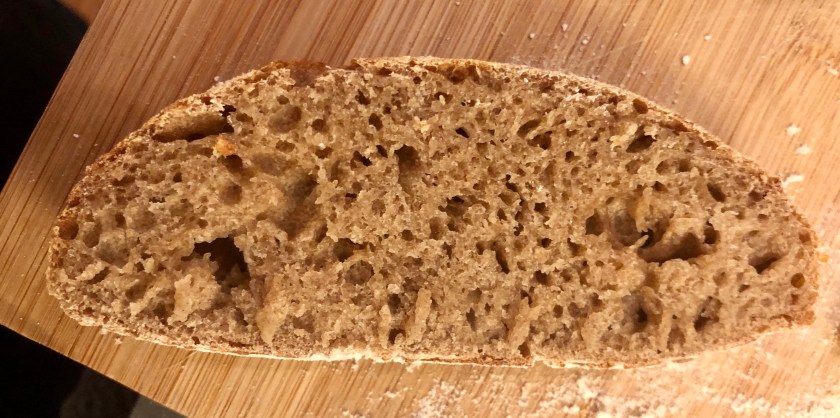
What did we do this time? I have a million notes, for reference, but we basically learned about all of the interesting aspects of strong starters, realized ours wasn’t quite there yet, and pushed forward anyway. We made a loaf and didn’t care whether it succeeded or not, just allowed ourselves to be curious. We baked it at midnight and slathered it in butter and ate a few slices still steaming. Our edibles kicked in and we passed out in bed, with the light still on.
Things we learned this round?
- Less starter is necessary. 1 tbsp. per whatever amount of flour you use will likely be plenty.
- Let the final rise happen in a form so the bread shapes whichever way you want it to.
- More gluten seems to be a good thing, so if you have bread flour, work with that.
- There is yeast and bacteria in flour and the air that can give sort of a false positive of a starter being active and can inhibit the good yeasts from forming activity. To avoid this difficulty, use pineapple juice in your starter as per the New York Times recipe OR just stir your starter a lot, giving it lots of oxygen, which the good yeasts love.
- Use more salt!
- Have more fun.
Love,
Julianne
 itinerant gastronomer